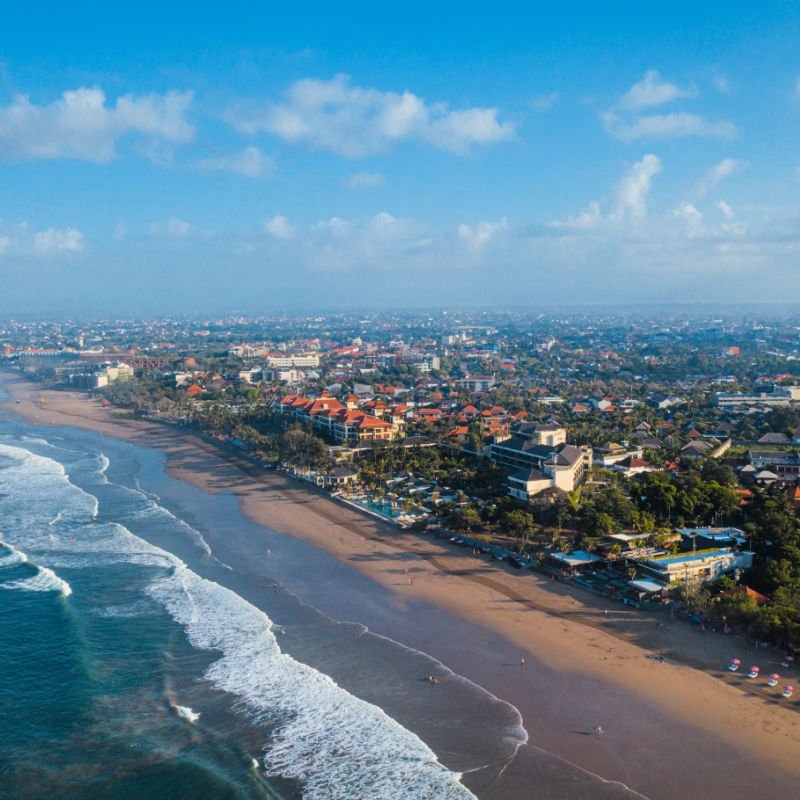

Kompas reports that small hotels in Bali are losing market share to private and small, unlicensed accommodation operators offered by digital platforms such as Airbnb. Competition from illegal accommodation providers is blamed for the current exodus of hotel operators selling their entire hotel businesses through online listings and other avenues.
To halt this business exodus, the Bali Provincial Administration is seeking ways to regulate accommodation offered online through digital platforms. Hariyadi BS Sukamdani, Chairman of the Indonesian Hotel and Restaurant Association (PHRI), said the government now requires properties listed on these applications to be officially registered accommodation businesses.
Hariyadi said these properties must possess a Business Identification Number (NIB) and other appropriate operating permits.
”The Ministry of Tourism has mandated that all application platforms register their properties—officially registering them so they have an NIB and the necessary permits,” Hariyadi said on Tuesday, 22 September 2026. He added that the government is now also monitoring properties offered through online applications such as Airbnb.
”The government isn’t banning Airbnb, but they must comply with regulations. If it fails to follow the rules, the site could potentially be blocked, making it inaccessible from Indonesia,” Hariyadi said.
Rising Tourism Trends:
Furthermore, according to Hariyadi, Bali hotels being sold online does not necessarily indicate a decline in Bali’s tourism industry. He noted that tourist visits to Bali are still trending upward, with figures reportedly surpassing pre-COVID-19 levels. “If we talk about Bali, it is likely still growing. By mid-last year, numbers had already exceeded the COVID-19 era—reaching 6 million. And this year, they will certainly rise further,” Hariyadi said. Bali’s tourism sector could still grow 5–10 percent, provided there are no extraordinary circumstances.
“The prevalence of Airbnb has indeed eroded the situation; individual owners are listing their properties on the platform,” said Hariyadi. According to Hariyadi, small hotel owners’ decision to sell their properties also hinges on their individual business calculations. “Regarding the sale of those relatively small hotels, the owners are likely crunching the numbers—if there is a profit to be made, they simply seek that profit,” he said.
Main Article: Bali Hotels by Airbnb

Meanwhile, the Bali Provincial Government says it will investigate reports that several hotels in Bali are being listed for sale on various online marketplaces and trading portals.
Bali Governor Wayan Koster has instructed the Bali Tourism Office to coordinate with the Badung Tourism Office and the Provincial Licensing Agency to verify licensing and registration information. “I have tasked the Head of the Bali Tourism Office with coordinating with the Badung Tourism Office and the Licensing Agency to gather data regarding reports of hotels being put up for sale,” Koster said when quoted by the State News Agency ANTARA.
Koster, saying it is largely “business as usual,” estimates that the sale of many hotels is linked to companies’ internal business dynamics rather than market sluggishness in Bali’s tourism sector. According to the Governor, several companies operate diversified business networks across regions outside Bali. Thus, if businesses in other regions face financial strain, profits from successful operations in Bali may be diverted to offset losses elsewhere.
”Tourism is actually on the rise; this is certainly related to their business affairs. There have been past instances where businesses operated not only in Bali—doing well locally but struggling elsewhere—resulting in profits generated here being siphoned off to cover losses elsewhere. In such circumstances. Businesses that are unable to sustain such pressure sometimes close their Bali operations and sell their properties,” Koster explained.
The Bali Provincial Government is also dismissing notions that hotels are being sold because of an oversupply of rooms caused by excessive hotel construction. Koster stated that overall hotel occupancy rates remain healthy, provided business operations are managed correctly and professionally. In fact, occupancy rates for star-rated hotels in Bali, Koster claims, average 80–90 percent.
Meanwhile, Kompas’s review of the official Rumah123 website found at least 20 hotels and villas currently listed for sale on the first page alone. The hotels listed on the front page of Rumah123 range in price from Rp 19 billion to Rp 600 billion and are located in various areas, including Kuta, Seminyak, Jimbaran, Ubud, and Amed. A similar situation exists on the online marketplace OLX, where various types of resorts at attractive price points—spread across different regions of the “Island of the Gods”—are offered to prospective investors.
Main Article: Bali Hotels by Airbnb
Bali Airport to Canggu Water Taxi Project
NusaBali says the timeline for building a water taxi pier at Perancak Beach, North Kuta, remains uncertain. The project, designed to provide an alternative maritime transport route from Bali’s Airport to the Canggu area, is currently awaiting the completion of at least 14 separate studies.
This was revealed during a public consultation regarding the proposed water taxi pier held at the Tibubeneng Village Head’s Office on Friday, 02 October 2026. Attendees included Made Agus Aryawan, Assistant II to the Badung Regent; representatives from various Badung regional government agencies; Tibubeneng community leaders; and representatives from the Perancak Beach Fishermen’s Group. Community feedback gathered during the public session will inform further analysis before the final decision on the pier’s construction.
The 14 required feasibility studies cover socio-cultural and environmental aspects, technical specifications, and the project’s potential impact on community activities and nearby sacred sites. The findings will determine whether and how the project proceeds, including the pier’s final design and location.
Residents raised several important points during the meeting. One community concern involved the proposed pier location, which infringes on areas used for traditional and religious activities. Participants urged officials to consider access to local temples, existing community activities, and the potential for creating additional traffic congestion.
Dr. Liz Zeny Merry, M.H., M.M., Assistant for Connectivity Support Facilities and Infrastructure at the Coordinating Ministry for Infrastructure and Regional Development, stated that planning for the water taxi project is still in its early stages. The consultation aimed to gather public input while presenting plans for alternative transport connecting Ngurah Rai Airport to major tourist areas.
According to Liz Merry, rising tourist arrivals in Bali threaten to place an increased burden on the road network, particularly in Canggu and its surrounding area. Consequently, a water taxi service is being evaluated as an alternative connectivity option for tourism. However, she emphasized that the project plans are not yet finalized. At least 14 studies remain incomplete before any final decision on construction can be made.
Main Article: Bali Hotels by Airbnb

“We are still in the early stages. 14 studies remain to be conducted, covering socio-cultural, environmental, and technical aspects. These will form the basis for determining the pier’s design and location,” said Liz.
The Berawa Beach area was considered in the preliminary study because its ocean wave characteristics are milder than at other points along the coast. This condition was a key technical factor in selecting the site.
However, technical aspects are not the only consideration. The presence of sacred areas and local customary activities around Perancak Beach necessitates a comprehensive review of the development plan.
Liz emphasized that the project should not be viewed solely in terms of physical infrastructure and transportation needs; the impact on the local community and the environment must also be carefully weighed.
“We want to improve the tourism experience and find solutions to traffic congestion. However, the development’s benefits must outweigh its impacts. Therefore, all community feedback will be included in the study,” she asserted.
The development’s impact on coastal conditions is also a concern. One specific issue is the breakwater’s potential to alter sedimentation patterns, which the preliminary study includes.
Regarding the planning phase, Udayana University has been conducting a feasibility study for over six months, starting last year. After the feasibility studies are completed, the process will then move to preparing the Detailed Engineering Design (DED). However, completing the studies and DED does not automatically mean construction can begin immediately.
“Several follow-up studies still need to be finalized, including socio-cultural and environmental assessments,” she said.
Budgeting is another factor; Liz noted that the funding source for the construction has not yet been finally confirmed. The project may require collaboration between the central government, the Badung Regency administration, the community, and the private sector. As a result, she could not yet confirm when pier construction would begin. “This is still the initial stage of communicating with the public. We do not want this plan to remain merely a concept. However, if the study results indicate it is not feasible, we must accept that. We must ensure the development does not cause more harm than good,” Liz emphasized.
Main Article: Bali Hotels by Airbnb
Main Article: Bali Hotels by Airbnb
Check-out our Services at Bali Hospitality Experts
Looking for Beach Villas in North Bali?